
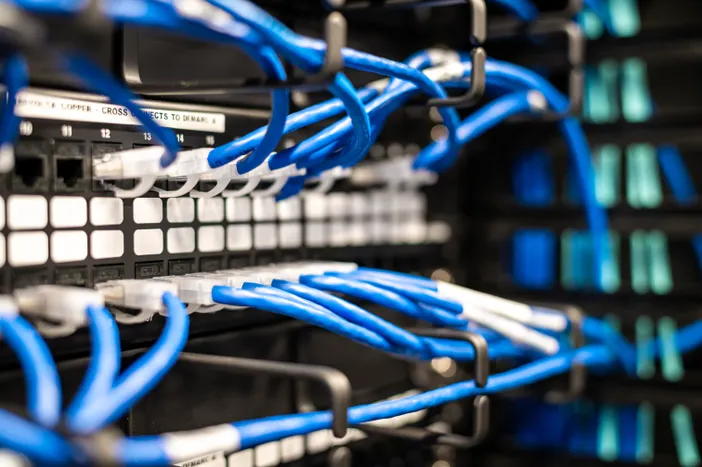
A ring network topology connects each device to exactly two others, forming a continuous loop through which data travels in one direction until it reaches its destination. Though less common today, the ring topology’s design still influences how certain fault-tolerant and industrial networks operate.
Quick Answer
The main advantages of a ring network topology are predictable data flow, reduced data collisions, and equal access for every connected device. The main disadvantages are that a single broken connection can disrupt the entire ring, adding or removing a device can interrupt the network, and troubleshooting is more difficult than in a star topology.
What Is a Ring Network Topology?
In a ring topology, devices connect in a closed loop, with each device linked to exactly two neighbours. Data travels around the ring in a single direction, passing through each device until it reaches the intended recipient. Historic implementations such as Token Ring, standardised under IEEE 802.5, used a token-passing method to control which device could transmit at any given time, avoiding the data collisions common in bus networks.
Advantages of a Ring Network Topology
- Predictable data flow. Because data moves in a defined direction around the ring, network behaviour is more predictable than in shared-cable designs.
- Reduced data collisions. Token-passing methods, historically used in ring networks, allow only one device to transmit at a time, avoiding collision-related slowdowns.
- Equal access for all devices. Every device gets a fair opportunity to transmit data, since the token or data packet passes sequentially around the ring.
- Performs consistently under load. Unlike some topologies, a ring network degrades more gracefully as traffic increases, since access is structured rather than contested.
Disadvantages of a Ring Network Topology
- Single break disrupts the network. In a basic ring, if one connection or device fails, data cannot complete its loop, disrupting the whole network unless a dual-ring or bypass mechanism is in place.
- Disruptive to modify. Adding or removing a device typically requires briefly breaking the ring, which can interrupt network activity.
- Harder to troubleshoot. Identifying which connection has failed can take longer than in a star topology, where each device has its own direct link to a central point.
- Slower than modern alternatives. Data may need to pass through multiple intermediate devices before reaching its destination, adding latency compared with switch-based networks.
- Largely superseded technology. Few new networks are built as pure ring topologies today, which limits the availability of specialised ring hardware and expertise.
Ring Topology Compared to Bus Topology
Both topologies were common in early networking, and both carry the risk of a single failure disrupting the whole network. A bus topology uses one open-ended shared cable, while a ring topology forms a closed loop with data flowing in one direction. See our guide on bus network topology advantages and disadvantages for the full comparison.
Where Ring Topology Concepts Still Apply
While pure Token Ring networks are largely obsolete, the underlying ring concept persists in resilient network designs such as dual-ring architectures used in some metropolitan area networks and industrial control systems, where a secondary ring provides redundancy if the primary connection fails.
How Modern Networks Improve on Basic Ring Design
- Dual-ring topologies add a second loop running in the opposite direction, so a single break does not disrupt the entire network
- Fibre Distributed Data Interface (FDDI) systems apply ring principles at higher speed with built-in fault tolerance
- Modern resilient ring protocols used in industrial and metropolitan networks can reroute traffic automatically within milliseconds of a fault being detected
Frequently Asked Questions
What is the main disadvantage of a ring network topology?
A single broken connection can disrupt the entire network, since data must travel through every device in the loop to reach its destination.
What is Token Ring?
Token Ring is an early ring network standard, defined under IEEE 802.5, that used a token-passing method to control which device could transmit data at any time.
Is ring topology still used today?
Pure ring topology is rare in modern networks, though dual-ring and resilient ring designs still appear in some industrial and metropolitan network systems.
How does a dual-ring topology improve reliability?
A dual-ring adds a second loop running in the opposite direction, so if one connection fails, data can still reach its destination via the second ring.
Why did star topology replace ring topology in most networks?
Star topology, built around a central switch, isolates failures to a single connection rather than disrupting the entire network, making it easier to maintain and troubleshoot.
Related Reading
- Bus Network Topology: Advantages and Disadvantages
- LAN Network: Advantages and Disadvantages
- Client-Server vs Peer-to-Peer Network
For historical reference on the Token Ring standard discussed in this guide, see the IEEE 802.5 standard documentation.